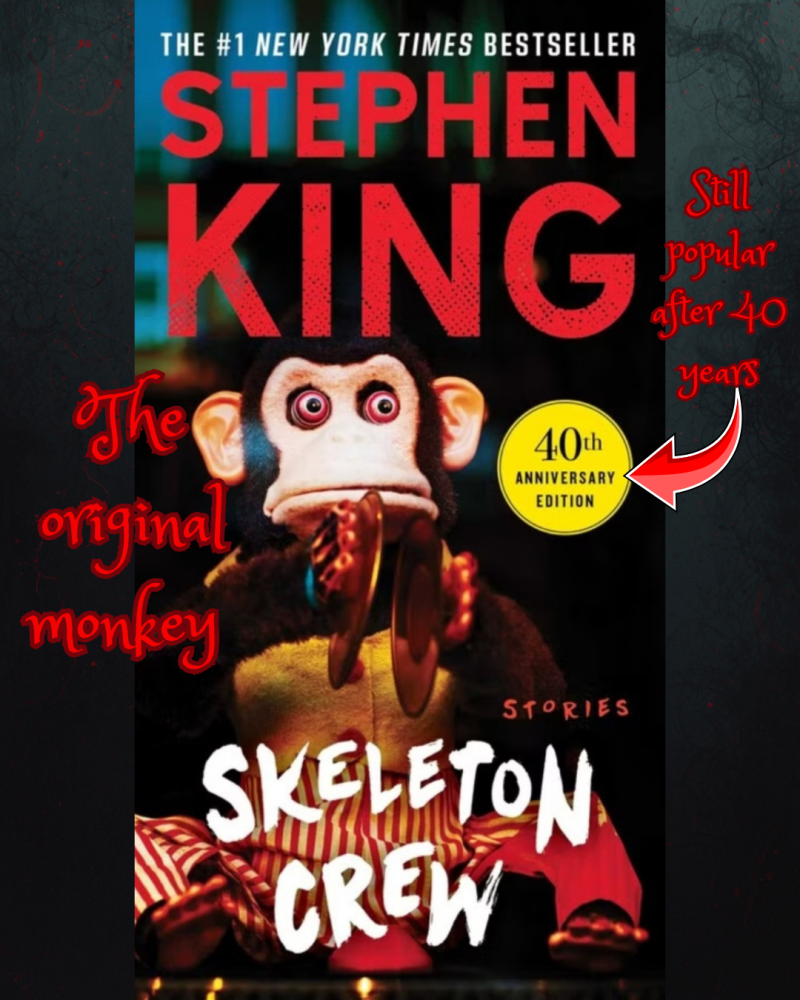
The aspect of adaptation with King has been well-documented, but as a writer the way in which storytelling is reshaped and manipulated depending on the medium is fascinating. Here, I’ll look at how King’s short story, The Monkey, published in 1980, has been adapted into a full length film. It was first published in Gallery magazine, then revised and published in his 1985 Skeleton Crew novel – a collection of short stories. The film adaptation, directed by Osgood Perkins, was released in 2025.
Although the film was changed from a serious horror to a satirical one, the narrative remains the same – a cursed monkey attaches itself to a family and brings death to them when activated. However, the main characters, Hal and Bill Shelburn are twins in the film, whereas in King’s story they are two years apart. Also, Hal’s son, Petey, is older. Their relationships are different too – Bill and Hal hate each other because Bill knows that Hal used the monkey in an attempt to kill him when they were teenagers, but killed their mother instead. In the short story, the monkey enticed Hal into turning the key when he was a child, unintentionally causing his mother to die due to a brain embolism (the film stuck to this cause of death). Bill never finds out as he thinks the monkey is just a toy – a popular one at that time. Moreover, in the film, Hal and Petey are estranged.
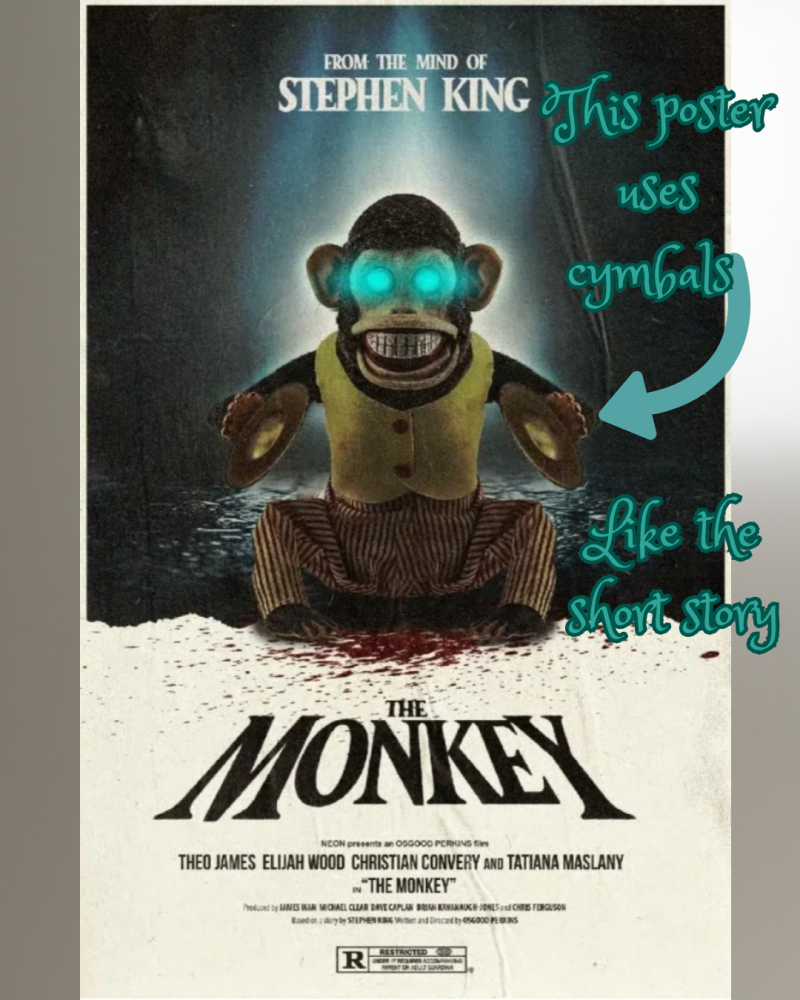
The biggest change is the musical instrument the monkey carries. In the story, it has crescent cymbals, but there was a problem when it came to the film, as Disney had already included this toy in Toy Story 3 and copyrighted it, so Perkins chose to give the monkey a drum instead. In an interview with GamesRadar+, Perkins told them “the drum is like a marching drum. It’s like, ‘Drum roll, please!’ before something happens. That’s better than cymbals. So thanks, Disney. I prefer it!” The drum does indeed add tension to the horror moment in the film, announcing another inevitable death. Cymbals are also effective in the short story but the drum has proven more impressive in the film medium.
The film had mostly negative reviews; one criticism being that it lacks depth, and rated only 5.9/10 on imdb. On imdb.com, they call it “an entertaining yet flawed horror addition”. However, I think it’s a good film, as I enjoyed the dark humour and visual beauty of the kills, as well as Theo James’ acting. But the ending in King’s story is a much better one, and would have translated really well to the big screen. Imagine what Osgood Perkins, could have done with the imagery of the old car wreck at the bottom of the lake, and the dead passengers receiving the monkey as it sinks; the ominous future possibility of a family hooking the monkey on a fishing line, and the curse commencing with them; and the image of hundreds of dead fish on a desolate beach. Instead, the story ends with the outcome of the family keeping an eye on the monkey by owning their curse.
Given the issues and criticism that arise from the short story, I’d like to give my view on Stephen King's use of racist language, which the film has brought up again. Having a racist character doesn’t mean the author is racist. Admittedly, using the phrase ‘nappy hair’ when describing a monkey, at that time, was inadvisable, and is historically a racial slur. But in recent decades, people have ‘reclaimed’ the word ‘nappy’ and it’s now used in a positive context to describe natural hair. His use of the slur ‘nigger’ is effective, and serves its purpose to shock the reader. King’s writing is based on realism. A part of that is having his characters experience racism, by other characters who are racist.


Add comment
Comments